


There is a name for the trader who always seems to give up and sell at exactly the wrong moment. This article explains the concept of weak hands vs strong hands in markets.
What “weak hands” actually means
Weak hands is trading slang for a position holder without the conviction, capital, or patience to survive normal volatility.
They chase action, take profits the moment they have any, and bail at the first uncomfortable dip. Not because their thesis broke, but because they can’t sit with the discomfort.
“Strong hands” are the opposite: they are well-capitalised, patient, and buying at the exact moments weak hands are selling.
A classic S&P 500 ‘shake out’
In July 2026 the S&P pulled back, and the “this is the top” calls came out in full force.. rate worries, AI-bubble, the usual kinds of arguments that sounds reasonable in the moment.
Anyone who sold into that dip is now watching from the sidelines as the index sit at a fresh record with the Dow through 54,000 for the first time.
The dip ‘did its job’ which is to create just enough doubt that the least convicted holders sell to the most convicted. Then the market moves on up.
It doesn’t take a crash, just a few uncomfortable red days that support any ‘doom’ narrative that appears.
Here’s our breakdown of how things ‘shook out’.
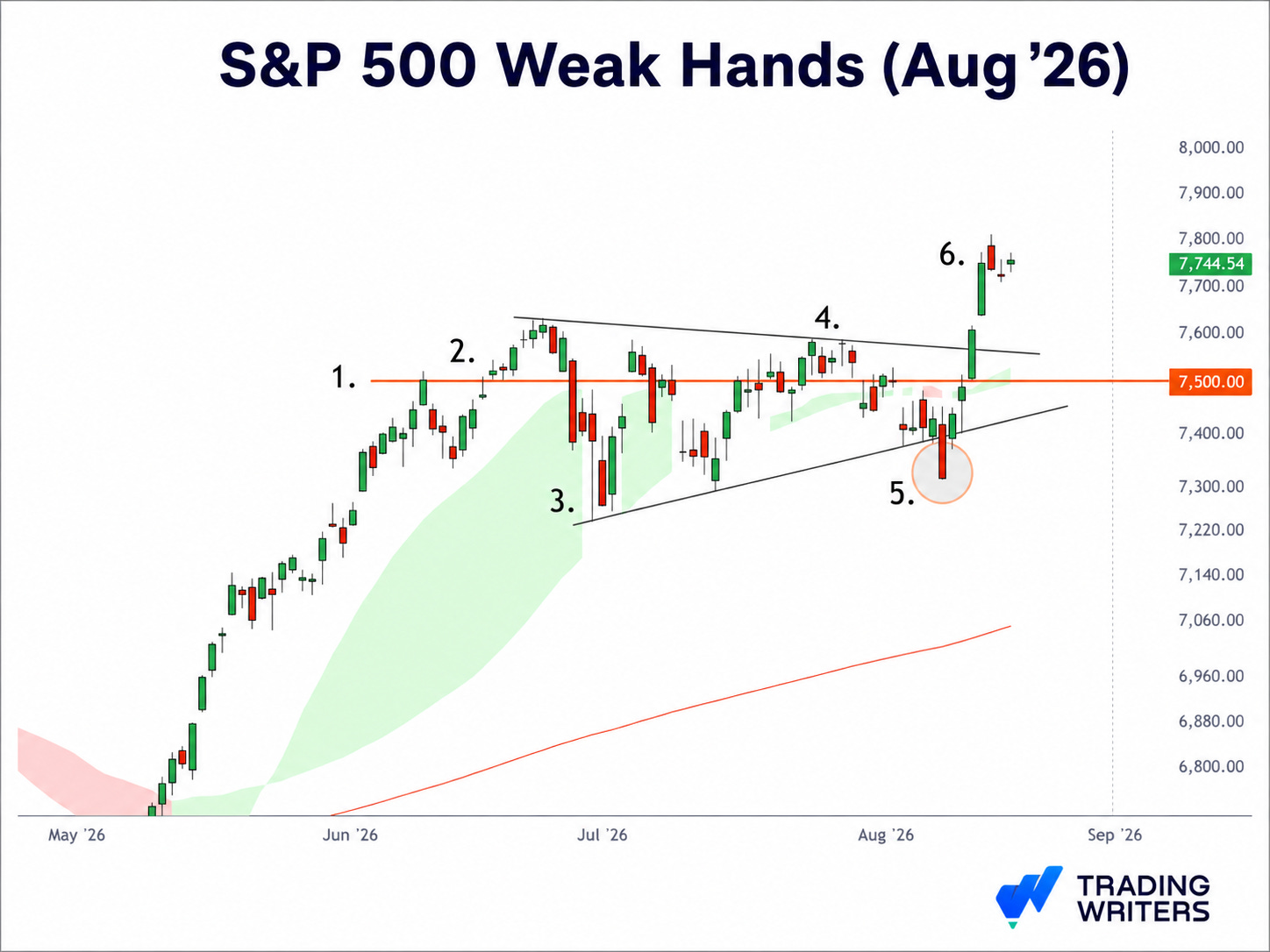
- The index hits 7,500 for the first time, profit-taking begins
- Fakeout to new highs, breakout traders get trapped
- Market takes out the prior low, triggering stop losses and new short positions
- Prior high gets tested as shorts get squeezed but reverses within the new range
- Trendline breaks and weak hands sell out
- False breakdown, support holds and price breaks out of triangle pattern
Market history: Weak hands vs strong hands
Long before regulators policed stock manipulation, professional ‘pool operators’ built entire campaigns around exploiting the weak hands.
Mark Holstead of Trader’s Mastermind lays out how the game worked: pool managers would quietly accumulate a position among themselves, then deliberately manufacture dull, grinding, back-and-forth price action.
Bored and frustrated, the weak-handed traders who’d bought in would sell out to the pool to clear the way for the real move to begin.
Richardson’s full rundown is worth reading, you can read it here
Why institutions engineer it on purpose
Sometimes a stop-loss gets hit on purpose.
Michael Huddleston, better known as ICT (Inner Circle Trader), built an entire trading framework i.e. Smart Money Concepts, around proving exactly that.
His core idea: large players need liquidity to fill big orders, and the easiest place to find it is exactly where retail clusters its stop-losses, just past an obvious high or low.
Price pushes just beyond that level, triggers the stops sitting there, then snaps back hard the other way. Retail gets stopped out or forced to cover, those orders become the liquidity the big players needed, and the “real” move starts immediately after.
This often leaves the shaken-out traders (err hmm Aschenbrenner) watching from the sidelines as the market runs in the direction they originally had right.
Plenty more on the framework on the official ICT YouTube channel
Livermore was describing weak hands a century ago
One of the oldest, most reliable patterns in trading was built specifically to fool anyone still holding after the first dip.
Jesse Livermore, the famed trader written about in Reminiscences of a Stock Operator, called it the “shakeout plus three.” Price makes a low, bounces, then drops to undercut that first low.
To an untrained eye it looks like the downtrend resuming; in practice it’s a second dip specifically designed to pressure anyone still holding from the first low into finally giving up their shares.
The confirmation comes on the reversal: once price rallies back above the first low by a meaningful margin on real volume, the shakeout is over and the actual move begins. The traders who sold the second low were the weak hands.
A century and a very different market structure later, it’s functionally the same mechanic ICT describes above — the label’s changed, the behaviour hasn’t.
How to avoid it according to Linda Raschke
Most traders try to catch the first bounce off a low, which means competing with everyone else, including the shakeout itself.
Linda Raschke, trader and author of the book ‘Trading Sardines’ has her own “Anti” strategy that does the opposite.
She waits through the consolidation, lets the weak hands get flushed out, and only then takes the second leg of the move i.e. after the selling pressure that would normally stop her out has already happened to someone else.
Raschke advises you to know before you enter whether your stop is sitting in an obvious, crowded spot, and if it is, expect it to get tested even when your overall read on the market is right.
Surviving the shakeout is sometimes just a matter of sizing and placement, not being smarter than the move.
More on Linda Raschke’s approach at lindaraschke.net
In short
Warren Buffett said “if you’ve been in a poker game for half an hour and you still don’t know who the patsy is, you’re the patsy.” The weak hands are the patsies of financial markets, arguably your main job as a trader is not to be one.


