


It intuitively makes a lot of sense to trade scheduled news releases like economic data or corporate earnings to capture the pickup in volatility.
But like all things trading, it’s not quite as simple as it seems.
So many try and most fail.
Real life news trading head fake
The Fed raising rates and signalling more hikes to come is (all else being equal) bullish for the US dollar, and bearish for gold and Bitcoin, right?
Yes it is. And othe dollar did rally initially on 16 September, 2026. But in the space of a day, the markets had reversed the kneejerk reaction to the Fed’s ‘news’.
Anybody who sold gold, Bitcoin or AI stocks in reaction to the Fed was simply offering ‘liquidity’ to the buyers looking to buy low.
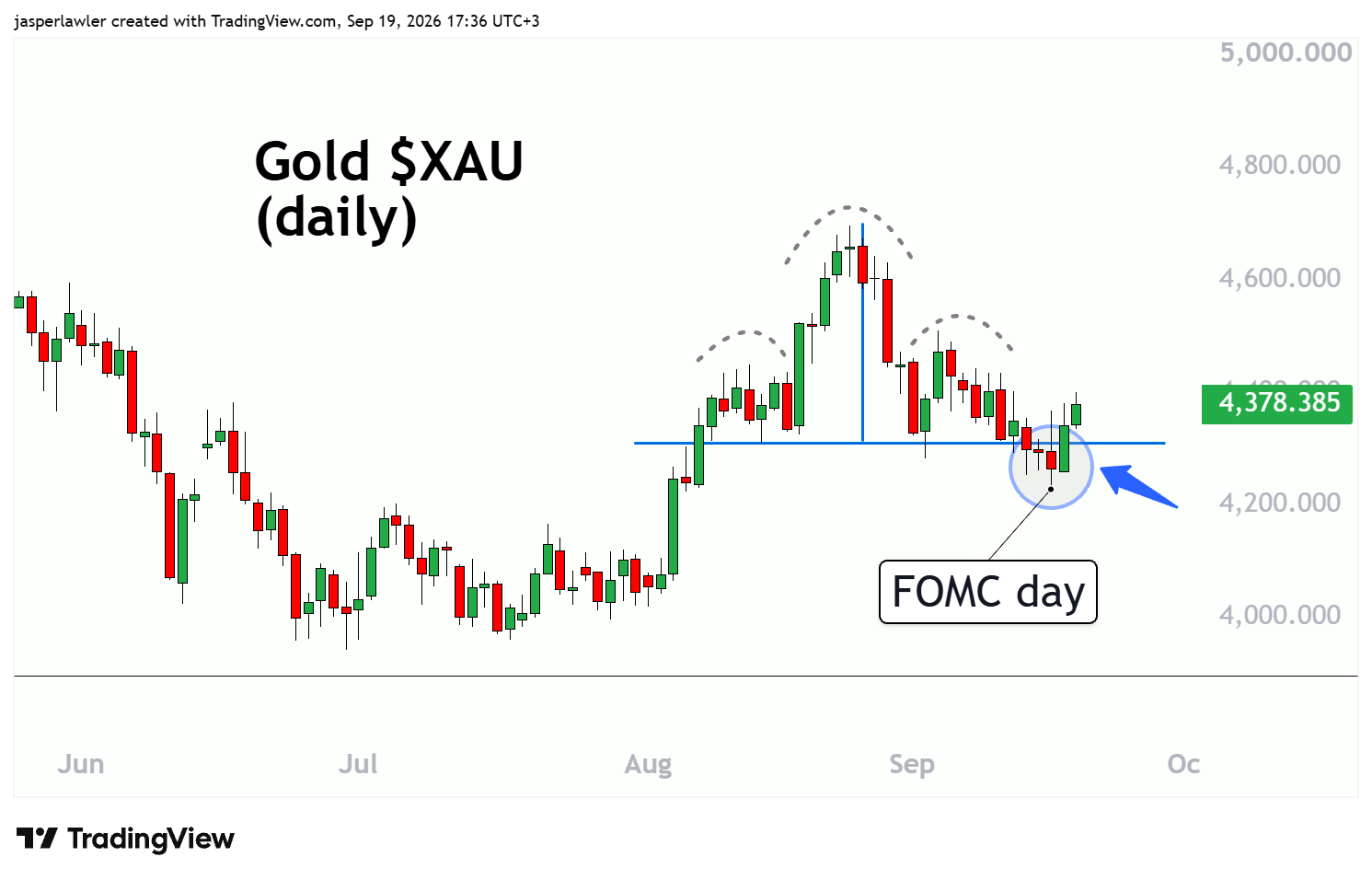
Pattern traders likely added to the liquidity pool via the ‘failed’ Head & Shoulders reversal pattern that you can see in the XAU/USD chart above.
As I see it, there are really four ways to trade the news:
- Don’t trade it
- Fade the initial move
- Trade the momentum
- Forecast and trade before it comes out
And I think I found the right traders to help outline each one and when to use it.
JC Parets on the market’s relationship to news
The old addage is ‘buy the rumour, sell the fact’.
When it’s in the news, it’s already been discounted and can quite often be a tip to ‘sell the news’.
All Star Chartist JC Parets, founder of TrendLabs writer of the ‘Everybody’s Wrong’ newsletter was one of the first to point out how alarming magazine covers, especially by the The Economist tend to correspond with turns in the market.

A digital mushroom cloud..? You can either laugh or cry.
Whether this specific call plays out or not, JC’s rule stays the same: once a trade is consensus enough to make the cover, the news itself stops being useful information.
“Journalists are historically late to the party,” Parets argues. Traders and investors spend weeks or months building a consensus view before a publication even notices it; by the time a story clears editorial approval, artwork, and print production, “that cycle is probably over.” He singles out The Economist as the best in the business at this, confirming, without meaning to, that a trend has already reached full consensus.
Read JC Parets’ full posts, “Short Their Optimism” and “The Envy of the World”, on All Star Charts.
Jason Shapiro’s news failure technique
Magazine covers are a great visual barometer of sentiment but it’s not like you can trade them in of themselves.
Jason Shapiro, founder of CrowdedMarketReport.com who was profiled in Jack Schwager’s Unknown Market Wizards book has a specific set of criterea to judge extreme sentiment and the right time to react ‘against’ the news.
His setup starts with positioning. Using the CFTC’s weekly Commitments of Traders data, he waits until speculators are massively crowded on one side of a futures market.
Then he needs the trigger: a piece of news that should confirm the crowded trade, and a market that does the opposite.
In a video posted on his YouTube Shapiro walks through the setup heading into a US employment report. Speculators were massively short the Dow and the Swiss franc, and gold’s speculative short was the smallest it had been in a while. The report came in hot, bearish for stocks and gold on paper, and bonds sold off as expected. The Dow and gold both made new lows intraday, then reversed and closed up. The Swiss franc did something similar a day earlier, closing higher even as the dollar rallied against every other currency.
That’s the failure: the news says one thing, the crowded market does the opposite, right at the turn.
Shapiro’s filter for whether it’s real: if you have to ask whether it’s a news failure, it probably isn’t. It should be obvious.
His execution is mechanical once the failure prints: buy or sell into it with a stop order at that day’s high or low. He doesn’t need to be right often since the setup is built for a roughly 4-to-1 reward-to-risk.
Watch Jason Shapiro’s full video:
The Straddle: Whichever way the news breaks
I know a good number of traders whp’ve made a career out of the straddle. But as I mentioned, it also happens to be the strategy that marked my biggest losing day trading.
It works for scheduled releases, so – a rate decision, an employment report, anything sitting on the economic calendar, the setup is a bracket.
The process is this: before the number drops, place a pending buy order above the current price and a pending sell order below it.
Each order becomes the other’s stop-loss: if the buy triggers, the sell order caps the loss on that side, and the reverse holds if price breaks down instead. Whichever way the release moves the market, one order fires and the other limits the damage.
The setup works because scheduled data reliably produces a sharp move within minutes of release, even when the direction is a coin flip. The volatility is close to guaranteed, so the strategy never needs to guess which way it breaks.
When the news markets the beginning of a new powerful trend, the straddle is a thing of beuty! The trouble is, as we’ve disccused, the market doesn’t always keep moving in its initial kneejerk reaction. In fact, it quite often jerks back and forth several times as traders get jossled out of their postions trying to work out what affect the news is really having on the price.
Not only this, the same volatility that makes the bracket work also produces slippage. So what can happen is, you can end up with a fill on your trade well past your intended level, which eats straight into the edge the setup is supposed to capture.
It’s the traders who know and accept that slippage combined with head fakes will drastically reduce the efficacy of straddles who can go on to make a killing using them.
Trading before the news happens (Josh Belanger)
Most traders wait for news to confirm, then react. Josh Belanger of Belanger Trading argues the real edge is trading what you already think is coming, before it’s news at all.
SpaceX’s IPO lockup makes the point cleanly. The exact date, freeing up to 911.5 million insider shares, more than the entire tradable float, was public from June. “Every desk on the Street has had that date circled ever since,” Belanger writes. Professional desks didn’t wait for the unlock morning; they sold into it for weeks in advance, and the stock bled 48% over that stretch before a single share actually traded.
The same week gave another example of why waiting for the news doesn’t work in the same stock. SpaceX beat earnings expectations with revenue up 92%, nearly a billion ahead of estimates. The stock then proceeded to give back the entire pre-earnings rally back within hours anyway. The good news arrived exactly as expected and the pros took their profits.
His whole approach: don’t wait to see what the news is. Read to understand what’s coming and trade it before it becomes news. Of course, easier said than done.
Read Josh Belanger’s full piece, “SpaceX Insiders DUMP Shares. BUY SIGNAL!,” on Belanger Trading here.
Takeaway
There are different ways to make a success of trading news but no matter you’re technique, you need to appreciate where he news fits in within the bigger picture- and under what circumstances your news trading edge works and when it doesn’t.


